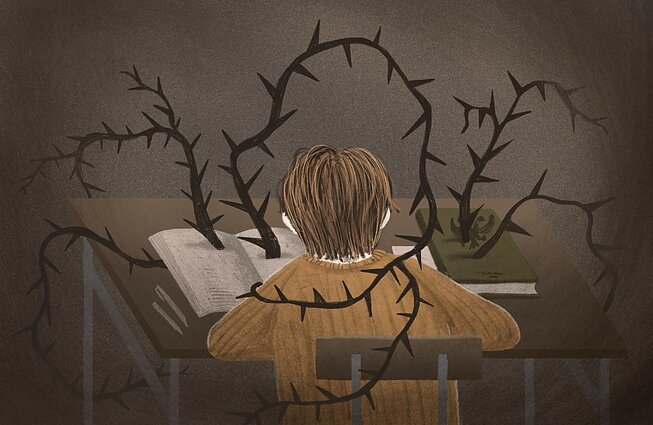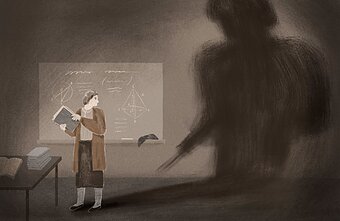






Russia’s occupation of Ukrainian territories is usually described in the language of war: front lines, trenches, drones, artillery. But another battle unfolds inside institutions and especially schools. Whoever controls the curriculum, the symbols on the walls, and history lessons controls the official version of reality.
This story follows three Ukrainian educators from different parts of Ukraine who witnessed firsthand Russia’s seizure of the local school system. The violence they faced at the hands of the new authorities – threats, detentions, interrogations, deportations – reveals a clear playbook. In territories that remain under occupation, it has proven effective.
The physical education teacher locked in a Russian penal colony
The takeover of schools in Kharkiv Oblast happened quickly and brutally.
On the first day of Russia’s invasion, February 24, 2022, Konstantyn Struk, 49, his wife Oksana, and their son Bohdan, woke to the sound of shelling. By afternoon, Russian armoured personnel carriers and tanks were already rolling through the centre of Mala Vovcha, the border town where the family had lived all their lives.
In the first days, the soldiers did not touch civilians. They assured them that they would “soon become Russians”.
In early March, checkpoints went up on the roads, manned by soldiers from the so-called DPR and LPR (the Donetsk and Luhansk People’s Republics). They urged obedience, warning that the regular Russian army would be “much more brutal”.
Soon, people began to disappear.
In late June and early July, teachers were summoned to the school. Two sheets of paper lay on the table. One for those who agreed to teach according to the Russian programme. The other was for those who refused. A local official appointed by the occupiers to oversee education – Wira Sorokova – shouted at the teachers and threatened that those who refused to cooperate would “end up starving”. Konstantyn and Oksana refused. They wrote resignations and collected their employment record books.
Although fierce fighting was underway in Kharkiv Oblast, the Russification of the education system proceeded methodically. Posts were filled by unqualified people who agreed to collaborate. Schools were incorporated into a new bureaucratic machine. Russian textbooks began arriving in classrooms. Even diplomas with “Russian Federation” printed on them made their way to the school.

Oksana saw no future for her family under occupation. In early August, she left with seventeen-year-old Bohdan for territory controlled by Kyiv. Konstantyn stayed behind. He kept saying no one would be interested in him because he was “just a PE teacher”.
Soon, Oksana learned from acquaintances that FSB officers were searching for teachers who had submitted resignations. She called her husband and told him to hide, not to stay overnight at home. However, he did not want to.
On the morning of August 14, armed men came to their house. First, they went to the neighbours, then they entered the Struks’ yard. They searched the house, took money and documents. They detained Konstantyn and drove him away with a sack over his head.
From that moment on, he was considered “missing without trace”.
The kindergarten director who got five minutes to pack
On the first day of the invasion, Halyna Slabko, 58, went to work at a kindergarten in Balakliia, a medium-sized town in Kharkiv Oblast. She organised an improvised shelter in the basement that usually served as storage for vegetables. As shelling intensified, people kept coming. The staff cooked food and calmed the children.
The Russian forces captured Balakliia on March 2.
Halyna and a colleague sent documents to the Ukrainian administration so employees could continue receiving their salaries. She hid sensitive documents: orders, personnel files, work record books. She destroyed files identifying children whose parents were ATO veterans (the so-called Anti-Terrorist Operation in Donbas) – she knew that in the hands of Russians, such information could endanger those families.
On August 18, members of the so-called “people’s militia” came to her apartment. They accused her of failing to hand over kindergarten property – computers and laptops – to the occupation authorities. They took her for questioning, during which two FSB officers were present. Then they led her out, put a sack over her head, and drove her to the police building.
In the cell was a school principal who had been detained the day before, Tetiana Semeniivna, and other women. One of them said that at night they could hear men screaming. The cell was cramped; mattresses lay on the floor. There were a toilet and a sink, but no running water. A guard called it a “female VIP cell”.
The next day, a guard asked whether the kindergarten director and the school director were inside. Tetiana was led out first. She returned in tears: she had been told she had five minutes to get ready for deportation. Halyna heard the same.
Again, sacks were put over their heads, and they were taken to an office with a camera. A man known to people who had been interrogated in Balakliia as “Murat” played a recording of a woman speaking Russian denouncing the SBU (Ukraine’s Security Service) and the Ukrainian army, blaming Ukraine for the war. The women were ordered to repeat the same thing on camera. Murat forced retakes, whenever the wording failed to satisfy him. Finally, after three attempts, he accepted a version that met his conditions.
Once she reached her home under guard, Halyna quickly gathered the essentials. So shaken that she could not find the warm coat hanging in her closet, she got into the car with her husband, thinking about the upcoming autumn. Under escort, the two cars set off toward Ukrainian positions. The road through the grey zone toward Kharkiv was a wasteland of craters, felled trees, and torn earth.
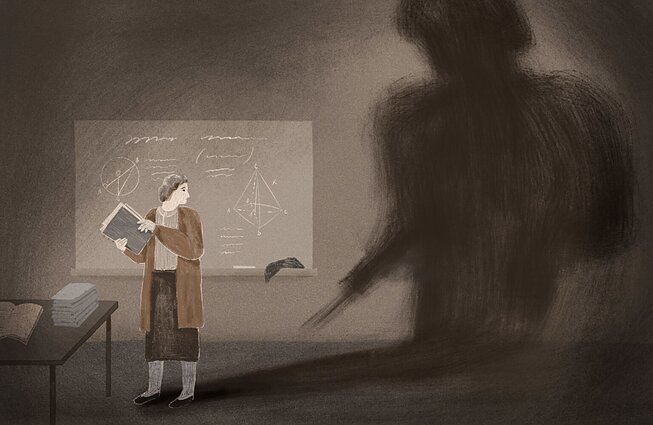
“Why did you even come?” – one meeting ended a career
For Zhanna Kriucheva, 58, the occupation came abruptly but changed her life forever.
Life narrowed to practical calculations: when to queue for bread, when not to leave the house, how to avoid searches.
The school in Andriivka, a village in Zaporizhzhia Oblast, suspended operations. Children stopped attending classes. Teachers took turns on duty, watching empty corridors as if guarding a museum of their own lives.
On June 21, Zhanna received a message that sounded almost ordinary: “Meeting – please arrive punctually.”
She had worked as a teacher for decades, teaching English and serving as deputy principal. Even before the full-scale invasion, she often argued with the school principal, Oleksandr Havrylov. She says he had pro-Russian sympathies for as long as she had known him. Now he had a chance to put them into practice.
At the meeting, the principal announced that the school would switch to the Russian programme. Then he began calling teachers one by one into his office, as though examining them.
He asked Kriucheva directly whether she would cooperate with the occupation authorities. She refused – without drama, but unequivocally. Havrylov replied sharply: “Then why did you even come?” Zhanna reminded him that he had summoned the whole staff and that, formally, she was still a teacher at a Ukrainian school. She then asked for her employment record book.
In the post-Soviet world, the employment record book is more than a document: it is proof of continuity, a life organised around a profession, a workplace, and years of service. Havrylov demanded that she write a letter of resignation. Zhanna refused again. She did not intend to “leave” a Ukrainian school; she refused to participate in its transformation into a Russian institution.
After the individual conversations, the entire staff was gathered again. Natalia Romanko, the occupiers’ appointed head of the village council, announced that “Ukraine is already the past and it will not return”. Teachers were told to accept the “new reality”. If they agreed immediately, they would be able to “simply work”. If they refused, they would lose their profession.
Kriucheva left the occupation in July 2022. She says she was less afraid than disgusted and humiliated by “living in the rear of the Russian army”. The sight of the Ukrainian flag as she was leaving occupied territory brought relief.
Two sides of the educational front line
The places the protagonists of this story call home now exist in different realities.
Mala Vovcha was liberated by the Ukrainian army in the autumn of 2022, but its proximity to the Russian border kept it too dangerous for civilian life, including schooling. Oksana was displaced. Her husband, Konstantyn, remains in Russian custody.
On November 30, 2022, the Russian Ministry of Defence sent notice through the International Committee of the Red Cross. About a year later, a brief letter arrived. Konstantyn wrote that he was alive and well, that he loved his family, and asked what they were doing to bring him back. He ended by saying he hoped they would see each other again.
Balakliia was liberated in September 2022 in a lightning Ukrainian counteroffensive. Many residents did not return because of the ongoing danger. By that autumn, Halyna was already back home. In her room, she found a warm coat hanging in plain sight in the closet. The local school, destroyed during the fighting, was rebuilt, but was later damaged again in a drone strike. Classes are now held online. Children gather in the underground shelter for extra lessons and an art programme.
Andriivka in Zaporizhzhia Oblast remains under occupation. Of the twenty teachers, eight initially refused to cooperate, but three eventually agreed. Besides Zhanna, only one other teacher left the occupied territory. From September 2022, the school followed the Russian curriculum. Pupils studied Russian history, stood under the Russian flag, and sang the anthem at assemblies. Some joined the Kremlin-backed “Movement of the First”, modelled on the Soviet pioneers.
The system behind the takeover
The stories of Oksana, Halyna and Zhanna are personal, but the pattern is systemic. The forcible takeover of schools was the first step in a broader campaign of occupation through education. According to Russia’s education minister, already by the end of 2022 some 1,300 schools in occupied territories had been folded into the Russian system, employing 36,000 teachers, many of them brought in from Russia.
This is likely to be a violation of international law, under which an occupier is generally required to preserve the existing legal order. Kareem Asfari, a legal analyst at The Reckoning Project, pointed out that under Article 43 of the Hague Regulations “an occupier must respect, unless absolutely prevented, the laws in force in the country”. In situations of long-term occupation, the Geneva framework, in turn, requires that necessary adjustments prioritise the welfare of the population, encompassing respect for educational institutions and for cultural, religious and family life – an emphasis that likely precludes large-scale ideological transformation.
According to the Ukrainian human rights organisation Almenda, a model tested for years in Crimea was rolled out after 2022 more quickly and more decisively. In 23 Russian textbooks found in schools in liberated parts of Kharkiv Oblast, researchers identified systematic pro-war propaganda: the myth of a “great Russia” that always wins, a totalising ethic of “service to the Fatherland”, and war heroes held up as models for children.
The new curriculum imposed by Russia is also likely to be unlawful. According to a report submitted by The Reckoning Project to the UN Committee on Economic, Social, and Cultural Rights (CESCR), Russia’s policy violates international human rights law, which requires education to “respect the child’s cultural identity, language and values, and country of origin”. Education must also be “acceptable” – that is, relevant, culturally appropriate, and of good quality – and cannot be used for “propaganda of war” or hatred.
The militarisation of Ukrainian children does not stop at propaganda. It is also a practical process with a clear end goal. Propaganda-laden “conversations about what matters” and “lessons of courage” with soldiers in classrooms are reinforced by weapons and drone training. At the same time, Russia is expanding cadet classes and paramilitary youth organisations.
According to Vladyslav Havrylov, a global fellow with the Collaborative on Global Children’s Issues at Georgetown University, the Russian authorities, working with collaborators, have created “a comprehensive system covering the entire child population in Ukraine’s occupied territories”.
He notes that the “Eaglets of Russia” targets the youngest children, usually aged seven to 13. As they grow older, they move into Yunarmiya, for ages eight to 18, the Movement of the First, for ages six to 17, and the Young Guard of United Russia.
“Most active participants are secondary school students – roughly 11 to 17 – as the programmes involve military-patriotic events, drills, shooting and “military-historical” re-enactments. These organisations carry out the targeted Russification of Ukrainian children in occupied Ukrainian territories, introduce Russian educational standards and, most importantly and dangerously, prepare future mobilization resources for the Russian army,” he said.
At the heart of this policy is the use of children as a tool of long-term demographic and identity change: forced or coerced removals, separation from parents, and subordination to Russian institutions.
According to Ukraine’s ombudsman, Dmytro Lubinets, more than 19,500 cases of the deportation and forced transfer of children have been identified. Some children are separated from their families in hospitals or during “filtration”, sent to so-called “recreation camps”, subjected to indoctrination, and sometimes placed in Russia’s adoption and guardianship system.
In March 2023, the International Criminal Court issued arrest warrants for Vladimir Putin and Maria Lvova-Belova, Russia’s commissioner for children’s rights, over the alleged war crimes of the unlawful deportation and unlawful transfer of Ukrainian children.
But while justice remains delayed, the system of indoctrination and militarisation is already producing its intended effects. Whether Russian propaganda truly shapes the minds of the generation growing up in occupied Ukrainian territories is a separate – and understudied – question. Its core purpose, however, is simpler: to legitimise Russia’s claim over their bodies, turning young men and women into soldiers to be trained, mobilised, and sent to fight and die in a war against their own country.
This text was created in collaboration with The Reckoning Project, a global team of journalists and lawyers documenting, publicising and building cases of war crimes. This story was originally published by the New Eastern Europe magazine, partners of LRT English.
Aleksander Palikot is a Kyiv-based reporter and correspondent covering politics, history and culture in Central and Eastern Europe.

Newsletter
Every Friday morning.